
The Invoice Follow-Up System: How Consultants and Freelancers Get Paid Without Awkward Emails
You did the work. You sent the invoice. Now you're doing the one job nobody put in the contract: waiting. Every consultant, freelancer, and studio owner knows the loop — draft the follow-up email in your head, delete it, decide they're a good client, wait another week. Meanwhile money you already earned sits in someone else's account.
2026-08-04 · 6 min read
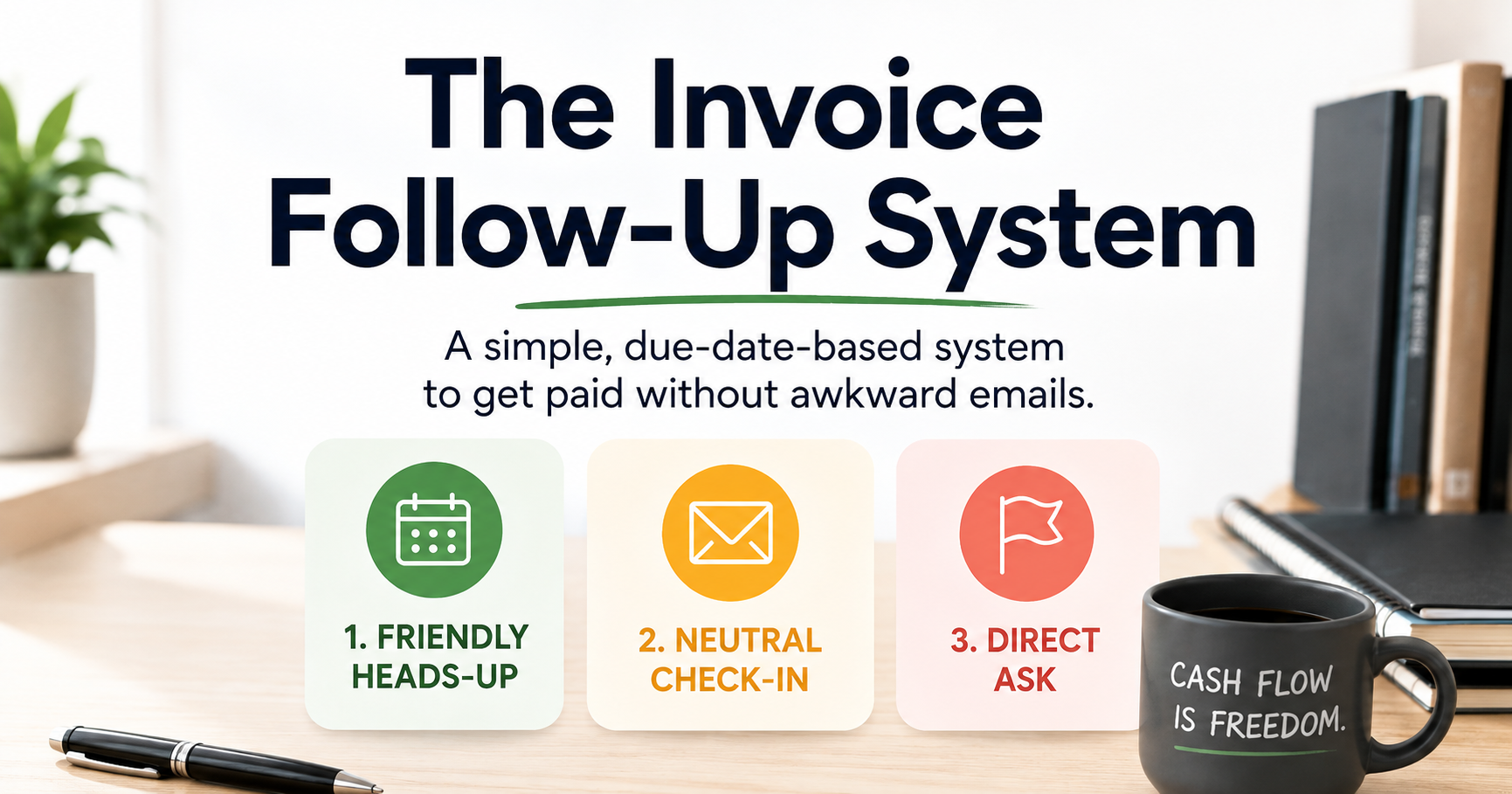
The Invoice Follow-Up System: How Consultants and Freelancers Get Paid Without Awkward Emails
You did the work. You sent the invoice. And now you're doing the one job nobody put in the contract: waiting.
If you run a consulting practice, a design studio, or any one-person professional service, you know the pattern. The invoice goes out, the client goes quiet, and somewhere around week three you start drafting a follow-up email in your head — then deleting it, because you don't want to seem pushy, and they're a good client, and surely it'll show up this week.
Meanwhile the money you already earned sits in someone else's account.
Here's the uncomfortable math: an invoice represents work you've completed and money you've earned — but not yet collected. Every week it sits unpaid, you're extending an interest-free loan to a client — often a client with far more cash than you. For a solo professional, even one or two unpaid invoices can create a meaningful cash-flow gap.
The fix isn't confidence, charisma, or a collections agency. It's a system — one that removes the emotional decision entirely. When following up is a calendar event instead of a judgment call, the awkwardness disappears, because you're not chasing anyone. The system is.
Why "waiting a bit longer" is the expensive option
Many unpaid invoices aren't late because the client is broke or unhappy. They're unpaid because your invoice landed in an inbox, got mentally filed as "later," and later never came. At larger clients, it may be sitting in an approvals queue nobody is watching.
That means one of the simplest things you can do is show up in the inbox again at the right moment. A short, polite nudge often gets a fast response — not because you applied pressure, but because you interrupted the forgetting.
The mistake most service providers make is anchoring follow-ups to how old the invoice feels rather than to its due date. Net 15 and Net 30 terms exist; an invoice that's 20 days old on Net 30 terms isn't late, and nudging it as if it were makes you look disorganized. Everything below keys off the due date, not the send date.
The system: three touchpoints, zero improvisation
You need exactly three emails, written once, reused forever. Each one is scheduled the day the invoice goes out — so future-you never has to decide whether today is the day to be "that person."
For invoices due on receipt, skip the pre-due reminder and begin with a friendly check-in three business days after sending.
Touchpoint 1 — Due date minus 3 days: the friendly heads-up
This one does the most work and feels the least like chasing, because nothing is late yet. It reads as good service, not collection.
Subject: Invoice #142 — due Friday
Hi [Name] — quick heads-up that invoice #142 ($4,800 for the March sprint) is due this Friday the 21st. Payment link is in the original email, or I can resend it. Let me know if anything's needed on my end to keep it moving.
If the invoice is stuck in an approvals process, this email is what shakes it loose before it's overdue. You'll often get a reply like "oh — forwarding to accounting now."
Touchpoint 2 — Due date plus 3 days: the neutral check-in
Still no accusation, no apology, no "sorry to bother you." Just facts and an easy exit ramp.
Subject: Re: Invoice #142 — due Friday
Hi [Name] — following up on invoice #142, which came due on the 21st. Wanted to check whether it's in process on your end, or if you need anything from me — a W-9, a different format, a resent link. Happy to help it along.
Notice what this email does: it assumes good faith, offers to remove obstacles, and replies in-thread so the full context is one scroll away. Many routine late invoices are resolved once the client confirms where the invoice is in its approval process.
Touchpoint 3 — Due date plus 10 days: the direct ask
Now you're allowed to be direct — still professional, but with a specific request and a specific date.
Subject: Invoice #142 — now 10 days past due
Hi [Name] — invoice #142 ($4,800) is now 10 days past due. Could you confirm when I can expect payment? If there's an issue with the invoice itself, tell me and I'll fix it today. Otherwise I'd appreciate payment by [specific date].
If this one goes unanswered, the problem isn't your email tone — it's the client relationship, and you should switch channels: a phone call, or the person who hired you rather than accounts payable.
Make it automatic or it won't happen
The system only works if it runs without willpower. The day you send an invoice, complete four quick steps:
The Invoice Send Checklist (copy this)
☐ Note the due date (not the send date) somewhere you'll actually see it ☐ Create reminders based on the payment terms: due − 3 days · due + 3 days · due + 10 days. For invoices due on receipt, skip the pre-due reminder and use send date + 3 business days and + 10 days. ☐ Save the three templates above as drafts or snippets so each follow-up takes under two minutes ☐ Log the invoice number, amount, client, and due date in one running list — so "who owes me right now?" has an answer that isn't "let me dig through my sent folder"
That last item matters more than it looks. When your outstanding invoices live in one list with due dates, the follow-up system becomes a two-minute Friday scan instead of an archaeology project. (If you already run a weekly five-minute review of who you worked for, who owes you, and what you spent — this list is the middle question, solved.)
Prevention: three habits that shrink the problem upstream
Follow-ups fix late invoices. These habits mean fewer invoices go late in the first place:
Invoice immediately. The longer the gap between finishing work and sending the invoice, the less urgent it feels on both sides. Same-day invoicing is one of the simplest high-return habits available to a service business.
Ask about the payment process before the work starts. One question — "who approves invoices on your side, and what's your typical payment timeline?" — tells you whether Net 30 actually means Net 45, and gives you a name for Touchpoint 3.
Make paying trivially easy. A payment link usually creates less friction than asking a client to prepare and mail a check. Every extra step between "I should pay this" and "paid" is a place the payment can stall.
The part nobody says out loud
Following up on your own invoices is not rude, needy, or bad for the relationship. It's the professional norm everywhere money changes hands — your clients' vendors do it to them, and their finance teams expect it. The service providers who get paid reliably aren't the pushy ones. They're the organized ones.
Corva One is being built for businesses like these — keeping quotes, invoices, payments, and direct job spending connected so "Who owes me, and when was it due?" becomes easier to answer. It organizes operational records for your accountant; it does not replace a full general ledger or tax system.
But you don't need any software to start. You need up to three saved emails, reminders tied to the payment terms, and one running invoice list. Set it up on your next invoice.
This article is general business education, not tax or accounting advice.